Laser or lamp projector: what actually changes
Deciding between a laser or lamp projector is not a matter of taste: it is a matter of hours. A mercury lamp is a cheap, lumen-generous light source that ages and eventually asks to be replaced; a laser engine costs more up front and, on paper, never sends that bill. Everything else, contrast, color, sharpness, lives in the panel and the electronics, not in the light source. Below I compare both with real numbers: manufacturer-rated lifespans, replacement lamp prices checked on EU stores, and a total-cost model that reads the fine print before the spreadsheet.
Rated hours: what spec sheets say, and skip
Straight from the factory data. Sony’s official specs for the VPL-HW45ES and VPL-VW520ES list a recommended lamp replacement time of 6,000 hours in Low mode, not Normal, which is lower. Epson rates its UHE living-room models around 3,500-6,000 hours in Normal, stretching to 12,000 in deep eco, a range visible across the ELPLP-series spare lamps that fit the EH-TW7100. BenQ is blunt on its European site: the MW826STh is rated 6,000/10,000/10,000/15,000 hours across Normal, Economic, SmartEco and LampSave modes.
On the laser side, Epson rates the EH-LS12000B light source at 20,000 hours in every mode. The footnote matters: that figure assumes five viewing hours a day in Eco, and marks where brightness has fallen to 50% of new, not where the projector dies. Sony states plainly that lamp hours are an expected maintenance interval, not a warranty. Manufacturer hours rest on eco modes and accelerated lab tests: accurate numbers when you read the footnote, far less so when a listing quotes only the biggest one.
Translation to real life: a lamp with 5,000 usable hours, at two films a night most nights (call it 1,000 hours a year), wants a replacement every five years or so. A 20,000-hour laser, at the same pace, runs into its second decade, well past the useful life of the electronics wrapped around it.
What a replacement lamp actually costs
This is where the argument gets concrete. Genuine Epson ELPLP-series lamps, the ones designed as user-replaceable parts, sat in a verifiable range on Amazon.it in October 2026: the genuine ELPLP85 for the EH-TW7100 and EH-TW7000 went for around 148 euros, and the genuine ELPLP89 for EH-TW9400-class models moved between 137 and 157 euros. Third-party compatible lamps drop to 45-80 euros, but vary wildly in bulb quality and in the driver electronics bolted to the housing. Sony’s LMP-series lamps trend pricier, and on native-4K models the swap often happens at a service center.
- Genuine lamp: color performance as designed, 130-160 euros on Epson’s home lines, warranty included. It also knocks your calibration around the least.
- Compatible lamp: 45-80 euros, with real risks: weaker bulb, color shift, moody hour counters. On a dedicated room the saving can cost you a recalibration.
- Disposal: mercury lamps belong at e-waste collection or with the retailer, not in household bins. The mercury is not a technicality.
Total cost of ownership: let’s actually do the sums
Two believable scenarios with the assumptions declared, because assumptions are where forum math goes to die. Setup: 1,000 hours a year (two hours of film most evenings, a real enthusiast’s pace), a seven-year horizon, a genuine 150-euro lamp every 5,000 real hours.
| Item | Lamp (1,200 euros) | Equivalent laser (2,500 euros) |
|---|---|---|
| Purchase | 1,200 | 2,500 |
| Hours in 7 years | 7,000 | 7,000 |
| Lamp replacements | 1-2 units, 150-300 | 0 |
| 7-year total | 1,350-1,500 | 2,500 |
Read that carefully: at this usage the lamp projector still wins, and not by a hair. The laser claws back the gap with heavy use, north of 1,500-2,000 hours a year, or when the gap between lamp and laser versions of the same model falls under 700-800 euros, which in 2026 happens more often in the mid-range. At casual use, 300-400 hours a year, a lamp can outlive your interest in the machine it sits in.
Fade, warm-up, dust: the hidden ledger
Purchase price is not the only axis, and here the laser has arguments spreadsheets miss. Fade: a lamp dims progressively and perceptibly long before hour 5,000 arrives, and owners routinely report noticing the drop much earlier, with colours drifting slightly green as the bulb ages. A laser fades far slower; Epson only claims its half-brightness point at the end of the 20,000 hours.
Warm-up: a laser is on the instant you press the button and stops almost instantly. A lamp warms for half a minute and demands cooling minutes at power-off; yanking the mains before the fan finishes is the most creative way known to kill a young lamp. Dust: lamp models have filters that want periodic cleaning, and filter-clogged overheating eats lamps faster than any aggressive lamp mode. Many laser units are sealed or nearly so.
The counterweight: at equal price, a lamp model almost always delivers more lumens than its laser sibling. The budget laser of 2026 is much better than five years ago, but lumens-per-euro still belong to the lamp.
Who should buy a lamp
Under 800 hours a year, two or three evenings of actual films with the lights off, the lamp is the rational pick: lowest entry price, more lumens per budget euro, and a spare you may never install. It also suits black-level hunters on a budget, since many lamp models still push iris behavior further than same-price lasers. And it suits people who simply refuse to abandon proven hardware: Epson’s EH-TW family and BenQ’s W series are alive and excellent.
Who should buy a laser
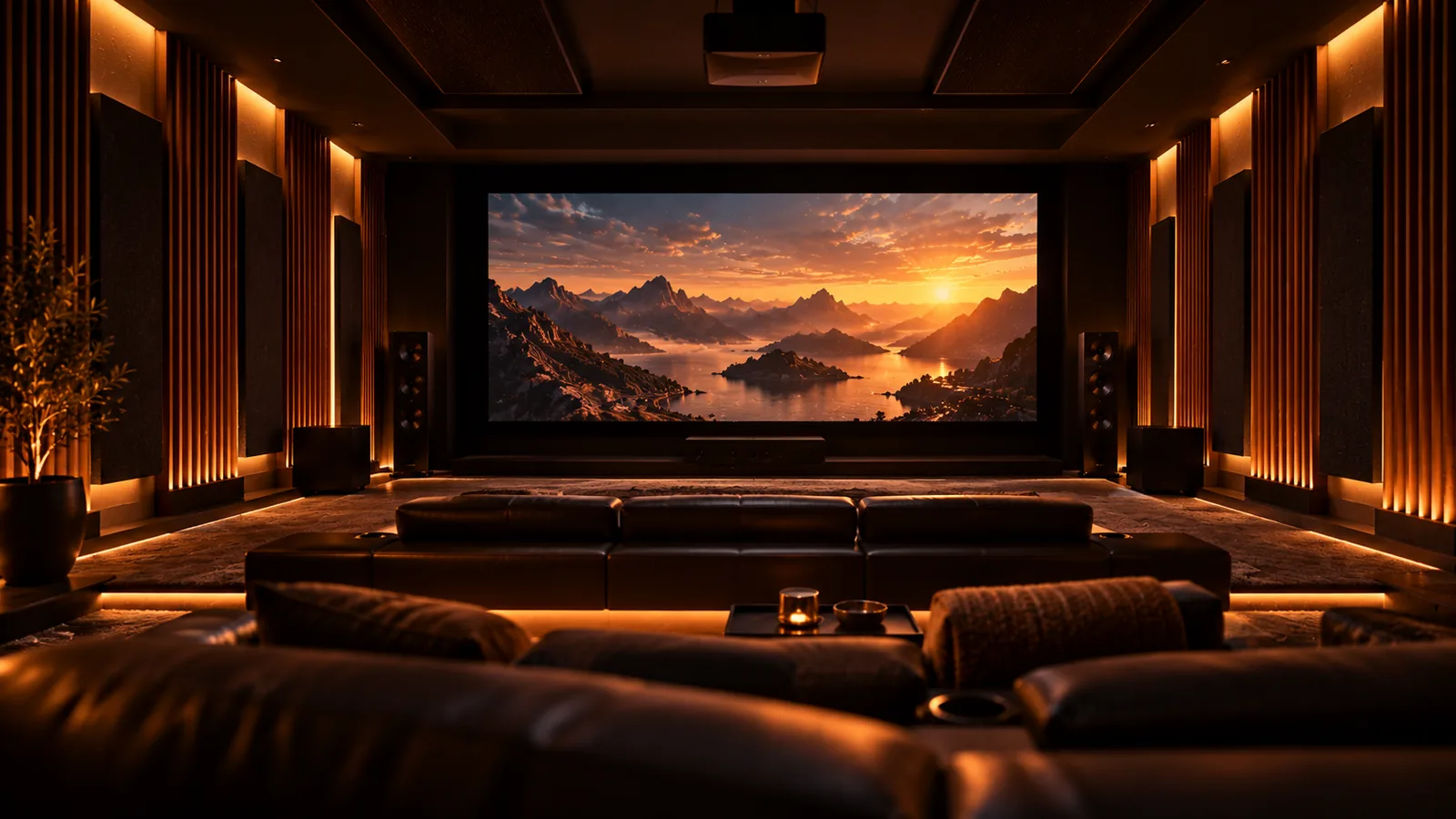
The laser is for heavy users, for anyone with a ceiling-mounted setup where a lamp swap is a gymnastics routine, and for people who want zero admin: no shelf spare, no filters, no warm-up. It is the only sane option in commercial rooms, where a dead lamp at the end of the evening means unhappy customers. Building from scratch with budget to spare, the laser removes a problem that eventually knocks. Already sitting on a healthy lamp projector under 3,000 hours? You owe nobody an upgrade; technology is not a moral tax.
Four questions before you order
How many hours a year will you really watch, real and not aspirational? Does the model you want exist in both versions, and at what price distance? Does your install make a lamp swap annoying or heroic? And can you accept brightness that gently declines, or do you demand peak output on the last day too?
If the dedicated-room, nightly-use profile is yours, revisit our projector buying guide, where the light source is one criterion among many. If the doubt sits further upstream, projector versus an enormous TV at all, the real-cost 100-inch comparison answers with watts in hand. And whatever you land on, skim the most common home cinema mistakes: a good share of disappointments are installed, not purchased.
The blunt answer, since you asked: the best machine is the one whose rated hours resemble your actual hours. Buying a laser for 200 hours a year is insurance against an accident that never happens; buying a lamp to run four hours a night just defers a bill that arrives, steeper, on the night of the final.
Gear and further reading
- 4K Dolby Vision projector with optical zoom
- Compact 4K projector with built-in stand
- High-brightness 4K laser projector
- Portable triple-laser 4K projector
- Projection screen
- Certified HDMI 2.1 cable with plated connectors
- 4K streaming stick with Wi-Fi 6
- Lens cleaning kit for projectors
- Blackout curtains for a cinema room
- 2.1 Dolby Atmos soundbar (mid range)
Note: Some links on this site are affiliate links: if you buy through them we may earn a commission at no extra cost to you. Affiliate links are marked and never influence our recommendations.