A home cinema projector makes sense for exactly one reason, and it is a matter of centimetres: beyond 98 inches, TVs stop existing or start asking for a mortgage. Below that line, a good panel usually wins. Everything else — lamp or laser, 4K, HDR — is a consequence of that geometric decision.
The catch is that a projector forgives far less than a TV: wrong light, wrong distance, wrong screen. Below are the three variables that decide everything, with real numbers and estimates clearly labelled as estimates.
Lumens and throw
A home cinema projector wins on one variable only: size. Lumens, throw and distance decide if that size is worth it — compare projector vs 100-inch TV. A properly sized home cinema projector beats any TV; an oversized one in a bright room beats nothing at all.
Start with ANSI lumens, the only unit worth taking seriously: it comes from the ANSI VP ID201-C procedure, which measures the actual image on a nine-point grid. Ignore “light source lumens”: they count the lamp’s output before the optics and inflate figures by up to 50% (an industry rule of thumb, not a lab measurement).
How much light do you actually need? The cinema reference is lower than you think: SMPTE sets 48 cd/m² on the screen (14 foot-Lamberts) as calibration white. That is why a dark, dedicated room gets by with far fewer lumens than the boxes shout: on a 100-inch image in total darkness, even 200-400 effective ANSI lumens at the cinema end of the dial are perfectly watchable — a practical estimate, not a lab measurement. A daytime living room with open windows wants 2,500-3,500, and at that point you are fighting physics.
Lamp modes matter as much as raw lumens: eco mode typically cuts 30-50% of the light output but stretches the lamp from a nominal 2,000-3,000 hours toward 10,000 (manufacturer claims). Laser units claim 20,000 hours and fade slowly instead of dying outright: different costs, same physics.
One last check before you buy, and the one nobody makes: the input voltage. Units imported from Japan often accept only 100/110/120 V fixed. On Europe’s 230 V mains they burn out or refuse to start. Confirm the spec sheet says 100-240 V auto-switching.
Throw ratio, in one line
The throw ratio is the distance-to-width relationship: distance = image width × ratio. A standard living-room zoom sits roughly between 1.2:1 and 1.6:1; a short-throw between 0.4:1 and 0.7:1; an ultra-short-throw laser (the “laser TV” on a cabinet) around 0.19-0.25:1, with the box 10-20 cm from the wall.
Before buying, actually measure the distance from the back of the sofa to the screen wall, then check it against the manufacturer’s throw calculator: every model has its own zoom range. And favor genuine lens shift (often ±50-60% vertical) over digital keystone correction: keystone resamples pixels and smears fine detail; lens shift moves the real optics.
Distance
Your eyes set the distance, not the furniture. THX recommends a 36° viewing angle from the furthest seat; SMPTE reference practice places the viewing position between 1.5 and 3.5 screen heights. For your living room, the comfortable zone sits between 30° and 40° horizontal: below 30° the image looks like a painting on a wall, above 40° you start turning your head like at a real cinema.
4K changes the maths. At equal diagonal, 4K pixels are a quarter the size, so the sensible distance shrinks. As a working estimate, with 4K you can come as close as 1-1.2 image diagonals without seeing the grid; with 1080p you cannot. Those are industry-handbook figures (imaging-science estimates, not formal standards), but they line up with THX’s angle.
| Diagonal | Width (16:9) | Throw @ 1.3:1 | Distance for ~36° |
|---|---|---|---|
| 100” | 2.21 m | 2.87 m | 3.4 m |
| 120” | 2.66 m | 3.46 m | 4.1 m |
| 135” | 2.99 m | 3.89 m | 4.6 m |
| 150” | 3.32 m | 4.32 m | 5.1 m |
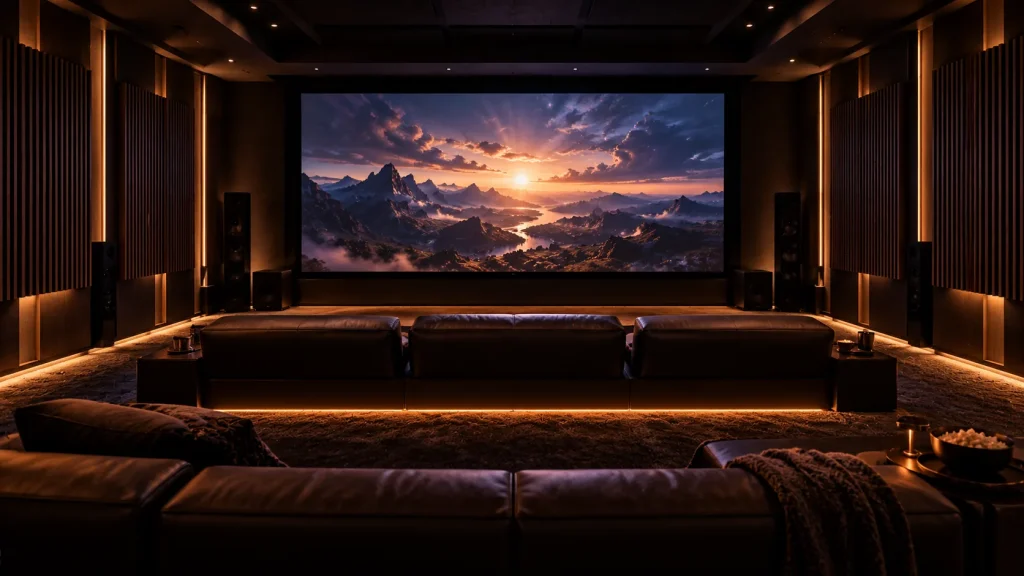
Read it this way: with 4.1 metres of usable depth between screen wall and the back of the room, a 120-inch image puts your first row exactly at the THX angle. Short room? Do not move the sofa back — drop the diagonal or fit a long-throw lens. And do not forget the audio side of the equation: our soundbar guide covers the no-wiring route.
The screen
The projector throws, the screen decides. A wall painted in optical white gives you a live image, but with weaker black levels and a tendency to wash out contrast. A real screen — framed or tensioned — costs about as much as a good HDMI cable and changes more than a 500-euro upgrade.
The key number is gain, the reflection factor: a white matte surface sits at gain 1.0, returning light evenly with the widest viewing angle. Gain 1.3-1.8 fabrics claw back light in bright rooms but narrow the angle and create hot-spotting, the bright patch in the middle. Rule of thumb: gain above 1.2 only when lumens are the actual problem, never for fashion.
ALR: when it earns its keep
ALR (ambient-light-rejecting) screens are light filters: they reject ambient light arriving from above and the sides while returning the projector’s light. They shine in living rooms with side windows and with ultra-short-throw projectors, which have dedicated ALR fabrics with sawtooth micro-structures. The price is real: many ALR fabrics sit below unity gain (0.6-1.0 typical) and show greyer blacks than a proper dark-room matte white. Real black comes from darkness, not from fabric.
On walls, SMPTE reference rooms demand dark, non-reflective finishes around the screen, with ambient reflections on the screen kept under 0.03 cd/m². Unrealistic at home, but the principle is not: dark matte walls, no white frames flanking the image, no downlights over the seating row.
Home cinema projector: what to weigh before buying
Plainly: if you mostly watch in daylight, in a bright glass-filled living room, a projector will frustrate you for three months and then gather dust except on match day. A good OLED or late-generation LED — see our OLED vs LED showdown — still wins in those conditions.
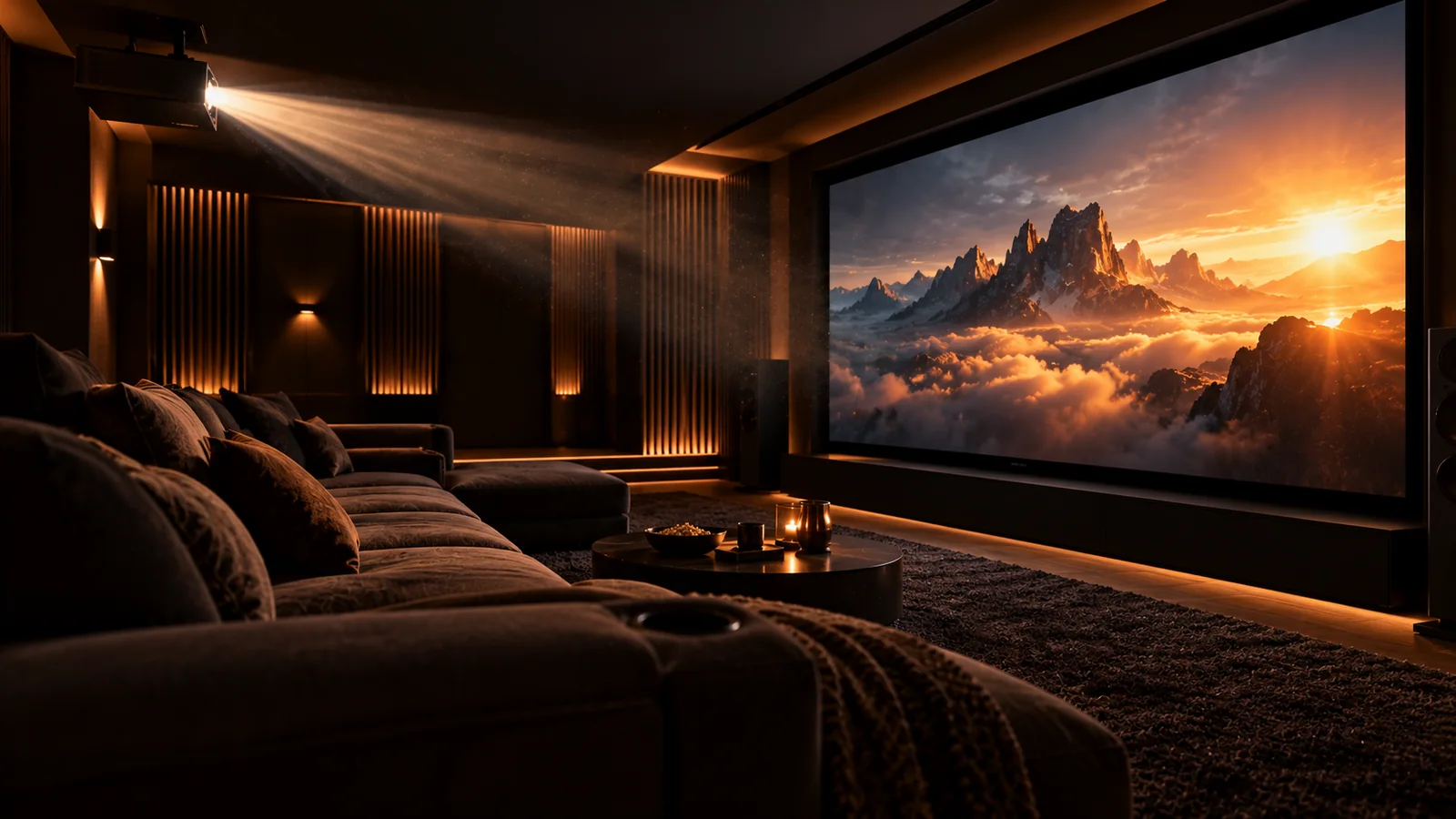
But if you have a free wall, a sofa 3.5-5 metres back and the ability to make darkness in the evening, a 120-inch-or-bigger home cinema projector is the purchase that changes how you watch films. To size the room, the seating and the cabling before spending a euro, start with the complete home cinema guide.
Gear and further reading
- 4K Dolby Vision projector with optical zoom
- Compact 4K projector with built-in stand
- High-brightness 4K laser projector
- Portable triple-laser 4K projector
- 3 meter 48 Gbps HDMI 2.1 cable
- Certified HDMI 2.1 cable with plated connectors
- 4K HDR streaming stick
- 7.2-channel AV receiver with Atmos and DTS:X
- Projection screen
- Active 25 cm subwoofer for living rooms
Note: Some links on this site are affiliate links: if you buy through them we may earn a commission at no extra cost to you. Affiliate links are marked and never influence our recommendations.