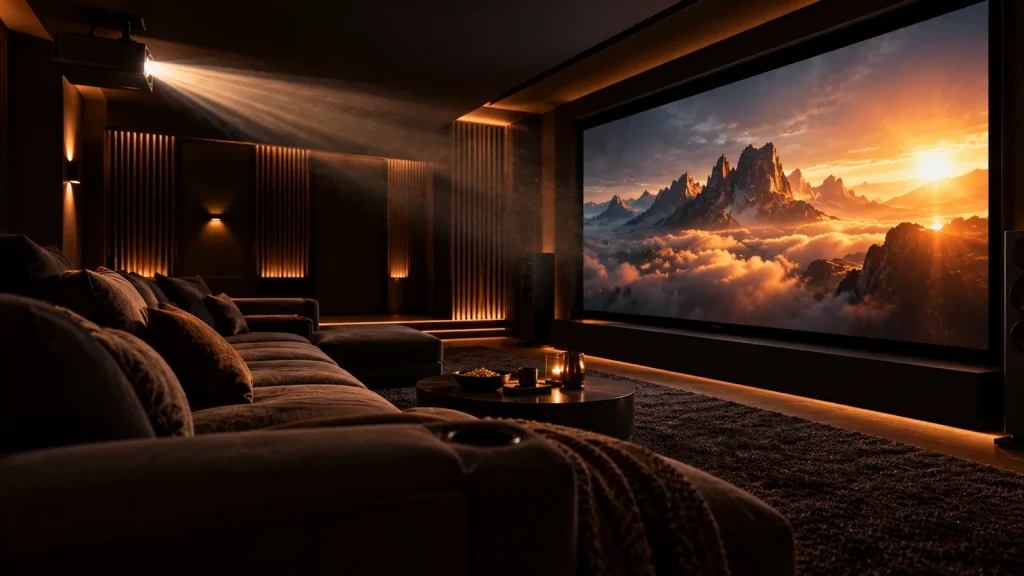
The screen and its placement: home theater room ideas
The best home theater room ideas are measured, not pinned: this is the geometry behind home theater room ideas that survive real movies. Pair with DIY acoustics. Home theater room ideas cost nothing until they contradict the math.
If you are researching home theater room ideas, start with the least exciting tool in the shop: a tape measure. A room that gives you chills is built by getting the room’s numbers into the right order, not by spending the most.
This guide sticks to real figures — SMPTE and THX viewing angles, a practical reverberation target, seat distances that hold up — and where no official number exists, the estimate is labeled as an estimate, never as a measurement.
The order follows our complete home cinema guide: screen first, room second, then the people who sit in it.
Screen fabric or painted wall?
With a projector, a properly painted matte white wall is a solid baseline: cheap, artifact-free, and the reference most calibrations start from. A tensioned screen earns its keep when you need a perfectly flat surface, a crisp black border, or a gain other than 1.0.
In a bright room, an ALR (Ambient Light Rejecting) fabric recovers contrast that a white wall simply loses. Be wary of gains above 1.3: they widen the hotspot and shrink the good viewing cone. In a dark, dedicated room, matte white at 1.0 gain remains the reference.
If your display is an OLED or LED TV instead, read our OLED vs LED comparison before paying full price for any fabric: room-light management changes completely.
Placement, height, light
- Screen center at seated eye level, or slightly above: in a dedicated room eyes aim at the lower third of the image, cinema-style; in a shared living room you sink toward center.
- Zero stray light on the image: no downlight hitting the fabric, no uncontrolled window. Perceived contrast is a lux problem, not a spec-sheet problem.
- Dark, matte surface opposite the screen: a light wall behind you bounces projector light back and washes out black levels.
You don’t need to do the trigonometry by hand: our tools section has a distance-to-diagonal calculator that applies the SMPTE and THX angles below.
How big, how far
SMPTE recommends a minimum horizontal viewing angle of 30° for the best seat in the house. THX pushes to 36° for the theatrical experience. In real meters, on a 16:9 image:
| Diagonal | Width | Height | Distance at 30° (SMPTE) | Distance at 36° (THX) |
|---|---|---|---|---|
| 100″ (254 cm) | 221 cm | 124 cm | ~4.1 m | ~3.4 m |
| 120″ (305 cm) | 266 cm | 149 cm | ~5.0 m | ~4.1 m |
| 138″ (350 cm) | 305 cm | 172 cm | ~5.7 m | ~4.7 m |
To be precise: those are geometric reference distances, not commandments. No seat sits closer than 2.4 times the screen height — under that threshold you exceed THX’s 36° ceiling, you start seeing pixels, and your neck pays. Near-sighted viewers and IMAX chasers can go closer; sports and subtitles favor more distance.
Baseline acoustics
A cinema room handles audio one of two ways: you manage it, or it manages you. The number that matters is RT60 — the time sound takes to decay by 60 dB after the source stops. For a dedicated room, the practical target is 0.3-0.5 seconds, biased to the short end in small rooms.
A living room with thin curtains, wood floors and a leather sofa usually sits well above that target: dialogue arrives mushy and explosions decay into a wash. Nobody is asking you to carpet every wall in foam — and absorptive panels do not stop sound reaching your neighbors; that takes mass and structural breaks.
The three treatments that actually move the needle
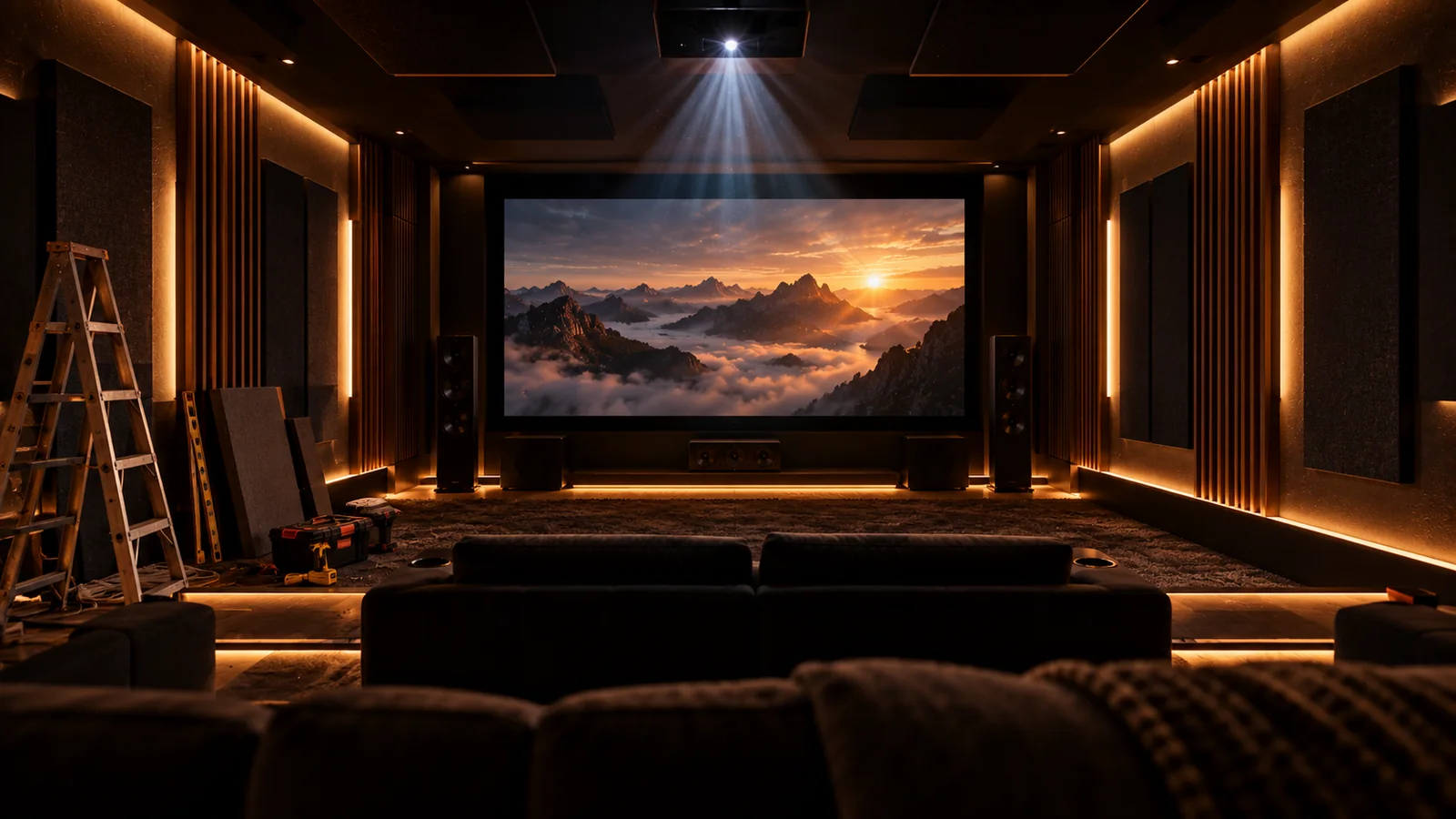
- First reflection points: the spots on side walls (and ceiling) where the front speakers mirror into your ears. An absorptive panel or heavy curtain there cleans up dialogue fast. Find them with the old mirror trick: seated, slide a mirror along the wall — wherever you see the tweeter is the point.
- Corners for bass: room corners pile up low-frequency energy and turn the subwoofer into a boomy blur. Corner treatment buys definition.
- A rug between sofa and screen: reflects far less than tile or wood. Lowest cost, most immediate gain.
How much each treatment helps depends on the room: without a measurement microphone those are estimates, not measurements. With a cheap USB mic and free analysis software you can check your real RT60 before and after. The gap between estimate and measurement is the difference between a forum and a lab.
If the room is a shared living room and wired 5.1 is off the table, a good soundbar with wireless sub covers most situations well — start with our soundbar guide.
Seating
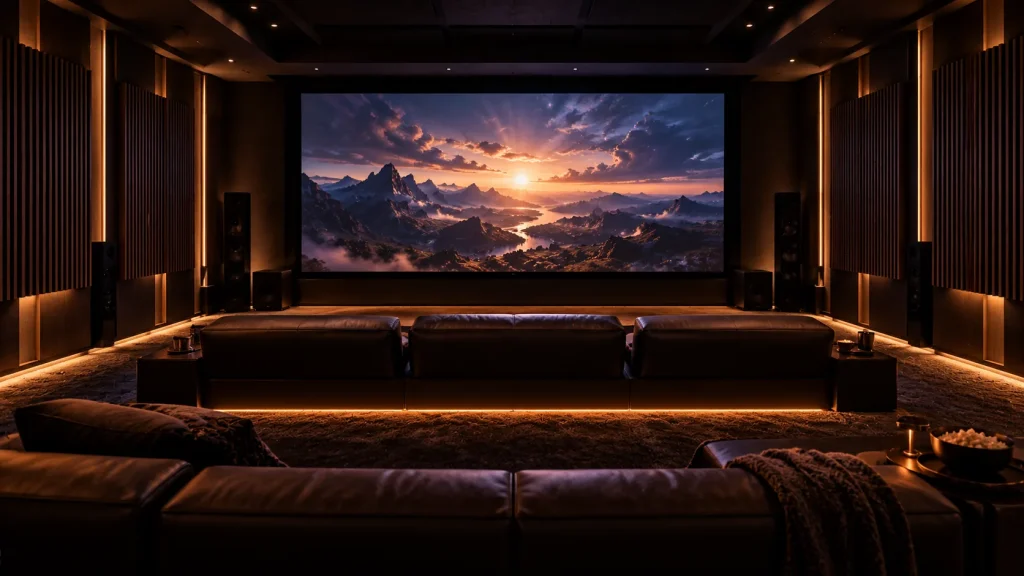
Seating is the last decision and the most underestimated. The criterion is not showroom comfort; it is room geometry.
Practical rule: the main seat never sits closer than about 2.4 times the screen height, keeping the viewing angle inside that 36° THX limit. On a 120-inch screen roughly 1.5 m tall, that means no closer than about 3.5 m; the SMPTE 30° angle sits around 5 m back.
Details that separate a cinema room from a living room
- Eyes level with image center: a high-backed seat helps; a sagging sofa has you looking up for two hours.
- Don’t glue the sofa to the back wall: 20-30 cm of clearance keeps seating out of the rear room nodes and leaves room for surround or dipole speakers.
- Stagger two rows if you have them: row two sees between heads, not behind necks.
- Recliners change geometry: reclined, your eye height and the sound trajectory both move. Pick your viewing position first, then design around it.
- Leave walkways: a minimum of 90 cm between seats and walls keeps the room usable in the dark.
One last number: a well-designed 15-20 m² room — correct screen, treated first reflections, seats at the right distance — beats a double-size room furnished by guesswork. Numbers first, catalogs second.
Gear and further reading
- Passive 5.1 home cinema set for an AV receiver
- 7.2-channel AV receiver with Atmos and DTS:X
- High-brightness 4K laser projector
- Large sound absorbing panels, set of 4
- 5 cm pyramid foam panels with tape
- Corner bass trap
- Laser distance meter for measuring the room
- Two-pack of 8K HDMI cables
- Blackout curtains for a cinema room
- Active 25 cm subwoofer for living rooms
Note: Some links on this site are affiliate links: if you buy through them we may earn a commission at no extra cost to you. Affiliate links are marked and never influence our recommendations.