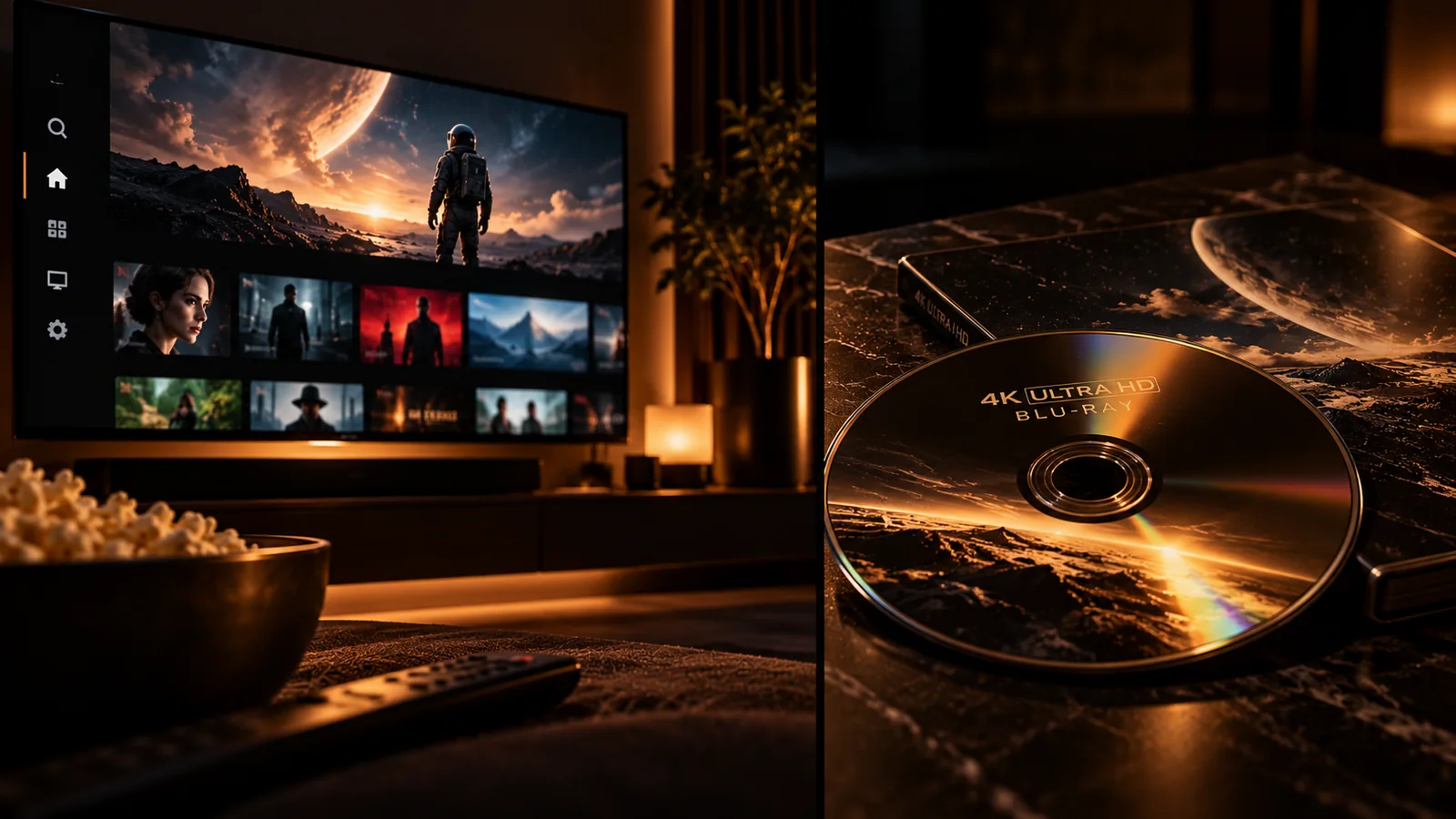
The 4K Blu-ray vs streaming debate never ends because both sides are half right. Streaming is convenient, cheap and “good enough”. The disc is faster, cleaner and pricier. The right question is not which format wins on paper, but which one wins in your room, on your screen, with your viewing habits.
Below are the real numbers: measured service bitrates, what an Ultra HD Blu-ray actually carries, and the monthly bill of both paths. Where a figure is a market estimate, it is labeled as one.
Picture quality: bitrate, color, audio
The 4K Blu-ray vs streaming debate comes down to three numbers. Run the comparison alongside the complete guide. 4K Blu-ray vs streaming is not a faith question: it is source bitrate, panel capability and rewatch habits.
4K video is not a resolution, it is a compressed data stream. At the same 3840×2160 pixels, what you see depends on how many bits per second the source can spend on hard scenes: rain, fire, snow texture, dense foliage.
Streaming has to fit inside bandwidth that passes through your connection and the service’s servers. Netflix typically delivers between 15 and 23 Mbps of real-world video on its flagship 4K titles. Disney+ can reach figures up to around 90 Mbps on its best-authored titles under good network conditions — a community-measured estimate, not an official spec. The Ultra HD Blu-ray disc carries 60-128 Mbps of HEVC video, plus lossless audio on top.
| Source | Typical video bitrate | Codec | Typical audio |
|---|---|---|---|
| Netflix 4K | ~15-23 Mbps | HEVC/AV1 | E-AC-3 (Dolby Digital Plus), lossy Dolby Atmos |
| Disney+ 4K | ~20-90 Mbps (estimates) | HEVC | E-AC-3, lossy Atmos |
| Ultra HD Blu-ray | 60-128 Mbps | HEVC | Dolby TrueHD / DTS-HD MA, lossless Atmos |
What does it look like to the naked eye? On a 65-75 inch screen at living-room distance, a well-encoded stream is close to the disc 90% of the time. Differences surface in dark moving scenes, in film grain (which streaming tends to smooth away or smear into moving artifacts) and in banding across gradient skies. The bigger the screen, the more bitrate matters: at 120 inches projected, the disc breathes.
Audio is the cleanest win: streaming almost always ships Dolby Digital Plus, a lossy format. The disc’s Atmos is TrueHD — bit-for-bit lossless. With a real system, you hear it in the height channels and in dialogue dynamics.
How much compression you forgive also depends on the panel: our OLED vs LED guide explains why OLED exposes banding that a well-calibrated LED hides.
The costs: 4K Blu-ray vs streaming, real numbers
Let’s run the numbers with conservative figures. These are market estimates (public price lists as of October 2026), to be recalculated for your retailer and region.
| Item | Streaming | Ultra HD Blu-ray |
|---|---|---|
| Entry cost | €0 (you own the TV) | ~€150-250 for a player |
| Recurring cost | ~€8-17/month per service | ~€20-30 per new disc |
| True 4K HDR | Mid/high tiers only | Native, always |
| Bandwidth needed | 25+ Mbps sustained | None (local disc) |
| Catalog | Huge but rotating | Yours forever, shrinking releases |
The break-even point is simple arithmetic. Buy three new UHD discs a month (€60-90) and streaming across two or three services under €20 wins. Watch two 4K films a month and keep them on the shelf, and a single €10 subscription leaves room for the disc — because the disc stays yours while the streaming catalog rotates out from under you.
Then there’s streaming’s invisible cost: the evening your connection saturates and adaptive bitrate drops you to 720p in the middle of the best scene. A disc has no adaptive bitrate: it delivers those 60-128 Mbps every single time.
When it pays off
Streaming wins if:
- you watch several services and series nightly, and total volume matters more than any single title;
- your screen is up to 65 inches at sofa distance, where compression shows least;
- most of your watching is light entertainment, which no disc mastering improves;
- you never want to think about regions, codecs and remuxes — you just want to press play.
Ultra HD Blu-ray wins if:
- you own a projector or a 75-inch-plus panel in a dark room — there, bitrate is visible;
- you run a 5.1.2-or-bigger system with lossless Atmos, and audio matters as much as video;
- you are a cinephile: commentaries, director-supervised transfers and restored editions do not exist in streaming;
- your connection is inconsistent and you refuse to let a congested node decide movie night.
The position of people who measure rather than cheer: keep both rails. One subscription as a discovery engine, the disc as a reference theater for the ten titles you will rewatch ten times. Before choosing, measure your network: our tools section has a bandwidth test, and the complete guide shows where each format fits in a chain that does justice to both.
Gear and further reading
- 4K streaming stick with Wi-Fi 6
- 4K HDR streaming stick
- Flagship 9.1.4 soundbar
- 7.2-channel AV receiver with Atmos and DTS:X
- Certified 2 meter HDMI 2.1 cable
- Wireless subwoofer
- 2.1 TV system with Bluetooth
- 12-piece hexagonal panels to start
- Universal remote for home cinema systems
- Compact 2.0 soundbar with virtual Atmos
Note: Some links on this site are affiliate links: if you buy through them we may earn a commission at no extra cost to you. Affiliate links are marked and never influence our recommendations.