The enthusiast’s minimum dictionary
Home cinema terms decide who buys well: this glossary of home cinema terms turns spec sheets into plain physics. Keep it next to surround systems and setup mistakes. Knowing home cinema terms is the cheapest upgrade of all.
Home cinema terms decide who buys well and who buys acronyms. Behind every spec sheet there is physics you can understand — you only need the right vocabulary. This page collects the terms you will actually meet in catalogs, forums and reviews, with plain definitions, including the ones retailers happily skip.
No acoustics-handbook filler: only what you need to choose a TV, audio and a projector without being talked into things. For the full picture, the complete home cinema guide connects every term to a purchase decision.
TV
The TV catalog is a graveyard of acronyms. These — plus nits — genuinely change performance.
| Term | Meaning |
|---|---|
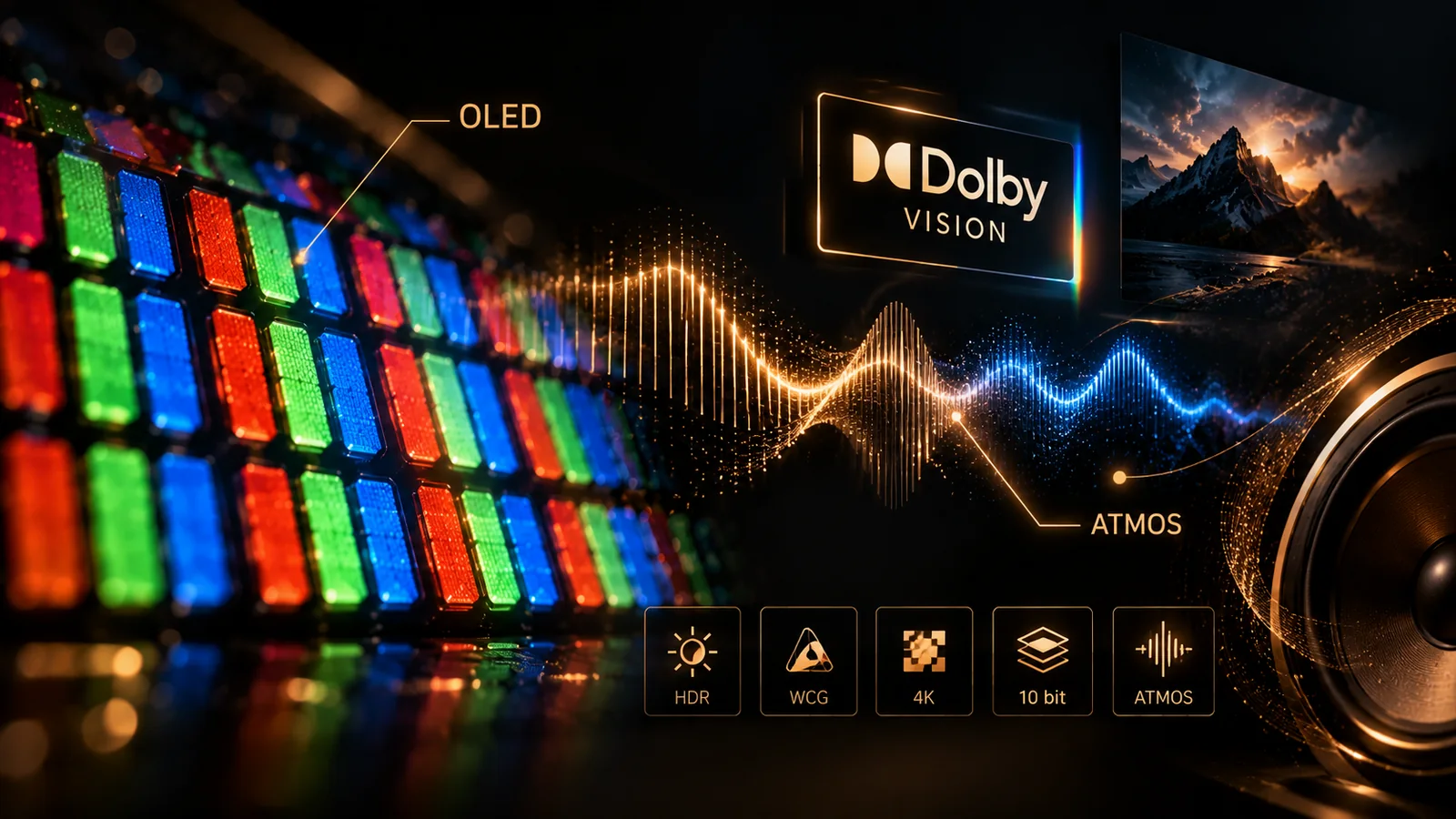
| Dolby Vision | An HDR format with dynamic metadata: the tone curve is remastered on a scene-by-scene, sometimes frame-by-frame basis. The television receives different instructions for different moments of the same film. Proprietary and certified; it costs royalties. |
| HDR10+ | The open answer to Dolby Vision: it also uses scene-level dynamic metadata, but was born as a royalty-free open standard, pushed mainly by Samsung. Backward compatible with static HDR10. |
| HDR10 | The baseline HDR standard: 10-bit and static metadata, a single mastering curve for the whole film. Every HDR discussion starts from here. |
| PWM (Pulse Width Modulation) | How many LED TVs control backlight brightness: they don’t lower the power, they pulse the LEDs on and off at high frequency. Usually invisible, but sensitive individuals can perceive eye strain or discomfort at low brightness. |
| Local dimming | An LCD backlight split into zones that dim or shut off where the frame asks for black. It reduces the dark-scene gray but introduces blooming, the light halo around bright objects on dark backgrounds. Grid extent and algorithm quality count, not the number of zones advertised. |
| Nit (cd/m²) | The unit of luminance: one nit is one candela per square meter. A well-calibrated SDR image runs on a few hundred nits; HDR mastering is built around much higher peaks, and peak luminance is the number that decides who wins against living-room reflections. |
| eARC | The evolved HDMI ARC port carries the television’s audio over a wide pipe: up to 37 Mbps, enough for uncompressed lossless audio up to 192 kHz at 24-bit and object-based audio such as full Atmos from the player. For comparison, optical tops out at a lossy 5.1. |
The practical difference between Dolby Vision and HDR10+ is decided by your source ecosystem, not by faith. If the doubt remains, the OLED versus LED and QLED guide explains how the panel filters all of this.
Audio
| Term | Meaning |
|---|---|
| 5.1 / 7.1.4 (notation) | The channel address: before the dot the ear-level channels, after the dot the subwoofer, after the second dot the ceiling height channels. |
| LFE (.1) | Low Frequency Effects: an effects-only channel recorded separately and bandwidth-limited by specification to roughly 120 Hz. It is not “the bass channel of the whole film”: it is the mix’s deep-effects track. |
| Crossover (bass management) | The filter that sorts frequencies: below the threshold sound goes to the subwoofer. The THX and Dolby reference threshold is 80 Hz, because below it sound is essentially non-directional. |
| Dolby Atmos | An object-based, not channel-based format: the mix carries a channel bed plus audio objects with position metadata that the processor renders onto your speaker layout in real time. |
| DBL (Dolby Binary Logic) | The technique that ships a multichannel stream inside two channels and lets the receiver unpack it: the “Dolby Digital 2ch” label on TV optical outputs. It loses little, but it is compressed. |
| Dipole / Bipole | Two-woofer surround speakers: out of phase (dipole) they create an enveloping field with no identifiable source; in phase (bipole) they deliver more direct energy. The classic choice for close side surrounds. |
| RT60 | The seconds it takes for sound to decay by 60 dB in the room. For a home theater the quality band sits roughly between 0.3 and 0.5 seconds: above it, dialogue starts stacking. |
Two of these terms matter more than the speakers: the crossover and RT60. Before adding channels, treat the room with a rug and a heavy curtain — it costs a few euros and returns more than a five-hundred upgrade. Real speakers and setups are in the buying guides.
Projectors
| Term | Meaning |
|---|---|
| ANSI lumen | Brightness measured on screen over a standardized grid — the only comparable projector number. The “light source lumens” of budget catalogs are a different number and not comparable. |
| ANSI contrast | Measured with the famous eight white/black checkerboard fields side by side, all lit at once: it captures real contrast in mixed content, which is what you watch in a film. Always lower than full on/off, and far more meaningful than half-screen checkerboard. |
| Screen gain | A screen’s reflection factor versus a reference diffuse white screen. Gain above 1 returns more light toward the center and raises perceived brightness, but narrows the useful viewing angle and can introduce hotspotting. |
| Throw ratio | The fixed ratio between projection distance and image diagonal: multiply it by your distance and you know the inches available. It tells you whether your wall supports 120 inches before you fall in love with the wrong model. |
| Native 4K / pixel shift | The chip shifts pixels within the frame to build the 3840×2160 image: XPR DLP chips deliver a full-resolution image, while native LCD panels remain the absolute reference. At real viewing distance the difference is minimal — and nowadays anything upscaled gets sold as “4K” too. |
| Lamp / LED-Laser | The light source decides brightness, color and maintenance: lamps lose light and drift color with hours; laser and LED sources hold brightness for thousands of hours but cost more upfront. |
| ALR screen | Ambient Light Rejecting: a screen that reflects projector light toward the seats and rejects lateral ambient light. No magic: in a bright living room it recovers contrast, it does not create it from nothing. |
Home cinema terms: frequently asked questions
Is HDR10+ worth a premium over HDR10? Only if you watch content mastered in HDR10+ and your TV supports it: without the content, the panel has no dynamic metadata to run.
How many nits do you actually need? For evening films in low light, perceived contrast matters more than absolute peak. With daylight and open blinds, peak luminance is the first filter.
Should PWM worry me? For most people, no: the working frequencies are far beyond perception. If an hour of viewing at low brightness leaves you uncomfortable, try a model with DC dimming and judge for yourself.
ANSI contrast or full on/off? The first says what you will see in a film; the second says what you will read on the spec sheet. Buy in the showroom and you risk buying the second number.
Gear and further reading
- 4K streaming stick with Wi-Fi 6
- 4K HDR streaming stick
- Certified HDMI 2.1 cable with plated connectors
- Compact 2.0 soundbar with virtual Atmos
- 5.1 kit with built-in digital decoder
- 7.2-channel AV receiver with Atmos and DTS:X
- Smart subwoofer with auto calibration
- 5 cm pyramid foam panels with tape
- Speaker cable
- Universal remote for home cinema systems
Note: Some links on this site are affiliate links: if you buy through them we may earn a commission at no extra cost to you. Affiliate links are marked and never influence our recommendations.