Watching a film on a 100-inch screen is not a gear-head flex: it is geometry. THX aims for a 36° viewing angle (the SMPTE reference sits at 30°); a 100-inch panel at 3.4 metres hands it to you in the living room. A 55-incher, at the same seat, leaves you well short.
The problem is price. A high-end 98-incher still costs like a good PC, a used car or a holiday for two. On paper, a projector delivers 120 inches for a fraction of that. But the purchase price is only the first instalment: behind it sit electricity, lamps and ambient light. Here are the real sums, not the flyer maths.
Projector vs 100 inch TV: the light bill
The projector vs 100 inch TV debate is decided by one variable: room light. Weigh it with OLED vs QLED and the projector guide. Projector vs 100 inch TV is a light bill, a black-level bill and a ten-year TCO bill — run all three before ordering anything.
Start with a number worth more than any spec sheet: emitted light grows with screen area, not with diagonal inches. Double the diagonal and you quadruple the area. Holding 300 cd/m² on a 100-inch screen takes roughly four times the lumens a 50-inch screen of the same tech needs. Projectors fold first under that punch: on huge diagonals they end up running well below the reference white.
The reference white, to be precise: SMPTE ST 431 pins 48 cd/m² (14 foot-Lamberts) as the theatrical screen luminance. Your TV shouts 300 cd/m² in small-window HDR tests; on a living-room projector at midday with the blinds up, forget it. Same image, entirely different experience.
Which is why the variable that moves everything is not your budget: it is the light in your room.
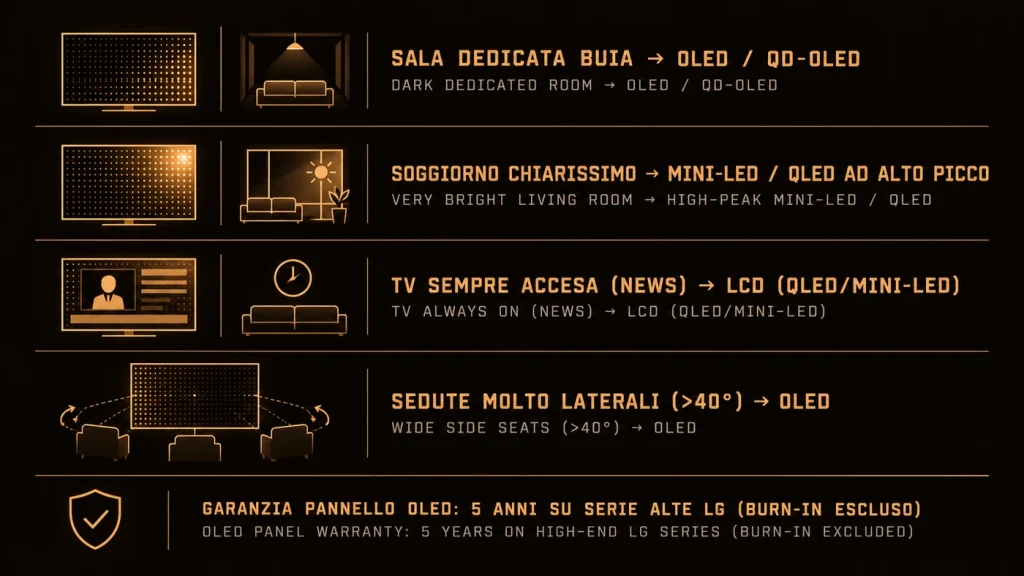
- Dark, dedicated room: the projector wins at nearly any budget. No TV fills 130-150 inches.
- Living room with light control (blackout curtains, no window opposite): technical draw, the wallet decides.
- Bright room, evening-only projection impossible: a big projected image is a faded rectangle. Stay on a TV up to 98 inches, or stop.
Before buying a two-thousand-euro box, buy a fifty-euro blackout curtain and see what your wall becomes. Best efficacy-to-price ratio in the whole affair.
Watts and years
What do the two roads actually draw? The EU energy labels are public and checkable, and they tell a counterintuitive story: a modern 98-incher — a Mini-LED with a 380-450 W maximum rating, an OLED rated up to 330-400 — under the label’s own SDR full-window-white (FVW) test often weighs less than a projector switched to normal mode.
| Setup | Typical draw | Note |
|---|---|---|
| Lamp projector 100-120", lamp mode | 190-250 W | eco mode: −30-50% light |
| Lamp projector, normal mode | 280-330 W | daylight brightness (rare) |
| 4K laser projector | 160-220 W | no lamp, 20,000 h claimed |
| 98" Mini-LED TV | 190-280 W (FVW) | max-rated 380-450 W |
| 83" OLED TV | 130-180 W (FVW) | follows content, not fixed |
Now in euros. Take five viewing hours a day: about 1,825 hours a year. Electricity cost ranges from 0.08 €/kWh (old fixed deals) to 0.40 €/kWh (untamed spot rates); I base the maths on 0.25 €/kWh and declare it an estimate, not a quote.
- Lamp projector in normal mode, 300 W: ~550 kWh/yr → ~€135/yr at 0.25 €/kWh. In lamp mode (220 W): ~€99/yr.
- Laser projector, 190 W: ~347 kWh/yr → ~€87/yr.
- 98" Mini-LED TV, 240 W: ~438 kWh/yr → ~€110/yr.
- 83" OLED TV, 160 W: ~292 kWh/yr → ~€73/yr.
On electricity, lasers and OLEDs win, and the big TV is not the power monster everyone imagines. But power is only half the instalment. The other half is the lamp: on lamp models, replacement — 200-400 € for the part, per the manufacturer — lands somewhere between 2,000 and 5,000 real hours, usage and dust depending. At 1,800 hours a year you swap lamps every 2-3 years. Laser claims 20,000 hours and fades slowly instead of blowing: you pay 800-1,500 € more today and the problem disappears. Declared-cost estimates, not lab figures.
And there is a third number nobody puts in the table: the screen. Projecting onto a white wall — the only way to keep the budget under the giant TV — earns perceived contrast in rooms that are not dark; an acoustic or micro-perforated tab adds 200-800 €. It fits the budget. Provided you add it before, not after.
The black test
Once the current is paid, the physics of contrast remains, and that is where the TV defends its title.
A projector never removes light: it modulates it. Even with the image off, in a dark room, the screen bounces back a floor of a few tenths of a cd/m². An OLED switches pixels off: black at zero watts, a contrast the data sheets call “infinite” because no other definition exists. A local-dimming Mini-LED pushes 1,500-2,500 nits in HDR windows but pays the blooming — the halo around white subtitles on black. Real differences, visible in end credits on black, not in action scenes.
The projector, though, plays at home when the room is dark and the screen is treated. An ALR (Ambient Light Rejecting) surface fights off grazing light and returns blacks a white wall could only dream of. A projector with properly set tone mapping and dynamic tone closes part of the HDR gap, even if a 2,000-nit-peak panel remains another class.
One last nerd detail: black-level uniformity on a big LCD TV — darker corners, clouding in gradients — is a concrete risk at 83-98 inches. A projector, by nature, is uniform everywhere. It flips the table exactly as much as black favours the TV.
In the end the choice is not technology versus technology. It is: how much light do you control, how many hours do you watch, and can you actually fit 100 inches at 2.2 metres. Budget is the consequence of those three answers, not the starting point.
If you have already chosen the panel, the OLED vs LED guide tells you which family wins in your room; if you lean towards the beam of light, the article on throw ratio and ANSI lumens is the natural sequel to this bill. To size the room properly, head for the measurement tools.
Gear and further reading
- 4K Dolby Vision projector with optical zoom
- Compact 4K projector with built-in stand
- High-brightness 4K laser projector
- Portable triple-laser 4K projector
- 4K HDR streaming stick
- 3 meter 48 Gbps HDMI 2.1 cable
- Projection screen
- Flagship 9.1.4 soundbar
- Laser distance meter for measuring the room
- Active 25 cm subwoofer for living rooms
Note: Some links on this site are affiliate links: if you buy through them we may earn a commission at no extra cost to you. Affiliate links are marked and never influence our recommendations.