The problem a soundbar actually solves
This soundbar buying guide starts from the room, not the catalog: the best soundbar buying guide is useless if you skip measurements. Pair it with setup mistakes and the glossary. A well-chosen bar beats a flagship in the wrong room.
Modern TVs are thin. It is a design problem dressed up as elegance: ten-centimeter cones do not fit in a twenty-millimeter shell, and four-centimeter speakers push air like wooden cuckoos.
Result: films with no bass, squashed dialogue, effects that only happen “in front”. The problem is not volume, it is physics: no amount of power replaces a cone that isn’t there.
The soundbar solves exactly this — not “make cinema in the living room”. Once you see the perimeter, the choice becomes a matter of room geometry and budget, with precise rules.
Reading the codes: 2.0, 3.1, 5.1.2 without marketing
A soundbar’s numbers are an address, not a slogan: first the ear-level channels, then the subwoofer, after the second dot the height channels.
- 2.0: just the bar. Lifts dialogue and clarity, zero spatial effect. Makes sense only under 250 EUR or in a bedroom.
- 2.1: bar + subwoofer. The bass arrives, the cinema does not: surround stays simulated by processing.
- 3.1: the bar hides a dedicated center channel besides left/right, plus the sub. The real breakthrough for “I can’t understand the voices”.
- 5.1 with rears: wireless satellites behind the seats. Here the surround is real: bullets passing by, rain behind you.
- 5.1.2: plus two upward channels (physical or up-firing bouncing) for Atmos.
The first enthusiast rule: the code matters less than the presence of a physical center. Bars that “extract” the center from stereo with DSP do half the job in scenes with music and voices at the same time.
The subwoofer: 80% of the “wow” is in there
If a soundbar ever seemed spectacular at the trade show, the subwoofer deserved the credit. This is the question that sorts the spec sheets: is the sub included, wired or wireless, what diameter?
Included 6.5-8 inch sub (200-400 EUR tier): takes away the TV drivers’ “buzz” and delivers the proper explosion. 10-12 inch sub (mid/high tier): really moves air and goes below 40 Hz — the physical carpet of action scenes.
Placement matters more than diameter. Do not stuff the sub into a shelf closed by wooden doors (it becomes a punch into a pillow) nor into the room’s far corner (it becomes a boom).
Even 30 centimeters change the low-end response: use the subwoofer calculator for the right cutoff, and give yourself a week of moving things before buying any miracle panel.
Atmos in a soundbar: what is real and what is physics
“Atmos” bars use upward-pointing drivers that bounce sound off the ceiling toward the seat. It works, with two by-the-book conditions, identical to the Dolby guidelines for bouncing modules.
First: flat, rigid, reflective ceiling — no sloped roofs, exposed beams or acoustic panels. Second: indicative height between 2.3 and 3.7 meters.
Crooked, tall or absorptive ceiling? The “helicopter overhead” effect dissolves: the driver fires into the void and no processor can invent a bounce the room cannot give.
Conclusion: on a good 5.1.2 in a regular room the effect is pleasant, but softer and less localizable than physical ceiling channels.
If the budget is a single one, the jump you really hear is stereo → dedicated center + sub. Bar Atmos is the cherry, not the cake.
The room rules the code
| Your case | Sensible code | Why |
|---|---|---|
| Bedroom or studio < 12 m² | Compact 2.1 | More channels in a small room create confusion, not cinema |
| Standard 15-25 m² living room, sofa on the wall | 3.1 with a good sub | Physical center + sub: solves 90% of complaints |
| Sofa in the middle, open plan | 3.1 or 5.1 with real rears | Without walls behind, simulated surround fades |
| Dedicated room or “movie” living room, 20-35 m² | 5.1.2 with wireless rears | Real surround + Atmos: here the bar gives its all |
| Very bouncy room (tiles, glass) | Anything + curtains and rug | Absorption first, then the code: see the acoustics section below |
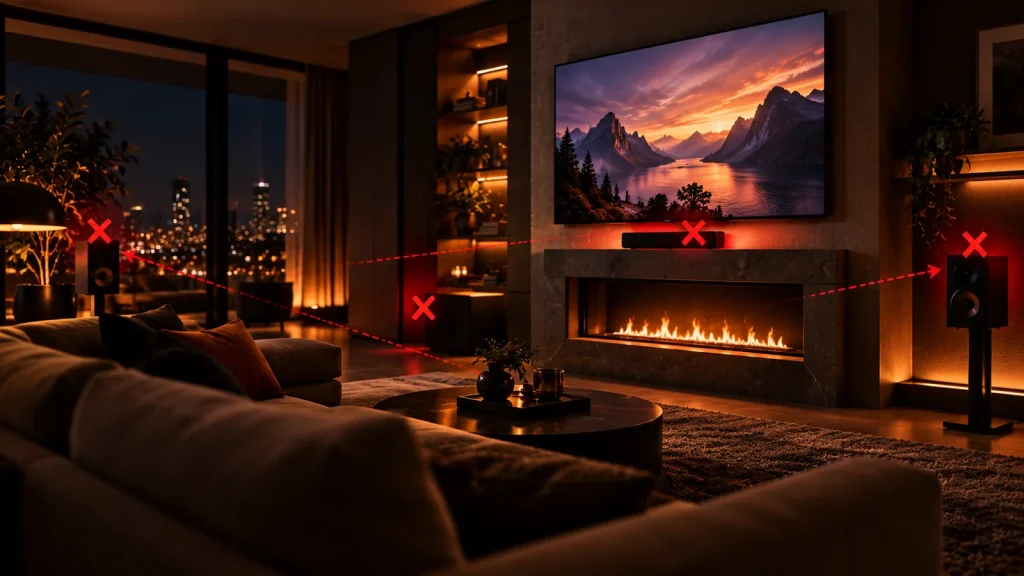
The datum nobody asks in the store: how much wall is behind the seats? Virtual surround works by bouncing off walls; in a loft open onto the kitchen the processor finds no walls, and you find no surround.
By budget: what to buy at each threshold
Under 250 EUR — the minimum vital jump. A brand-name 2.1 bar with wireless sub: dialogue goes from TV cuckoos to human voices, with real lower-mids underneath. Expect zero surround and zero Atmos. That is not a flaw: it is the right price for not having to ask “what did he say?”.
250-500 EUR — the smart tier. 3.1 bars with 8-10 inch subs. Dedicated physical center, a sub that goes down to the basement, eARC so audio is not bottled up. It is the configuration I recommend to most people: in a living room it beats any suitcase home theater with 8 cm satellites.
500-1,000 EUR — the “room” bar. 5.1.2 complete with wireless rears and 10-inch sub. Here the bar becomes a system: real surround, decent bouncing Atmos on regular ceilings. Compare by reading the driver layout (how many real mid-woofers, which aiming angles), not the fantasy watts printed on the box.
Over 1,000 EUR — the right question. At these figures the flagship bar fights a separate system (AVR + speakers) that, at equal price, plays in a higher league. You buy a 1,000+ euro bar for aesthetics and zero wires, not for pure performance.
The two cables that decide everything (and one to avoid)
Connect the soundbar to the TV with HDMI eARC: it is the only channel that carries modern audio without dropping it along the way — up to 37 Mbps versus the optical’s ~384 kbps.
The TOSLINK cable that “works anyway” carries at most compressed Dolby Digital: fine for a 2012 TV, not for your system.
Second check: look at which HDMI ports on the TV carry the eARC label. On many models only one of three does, and TVs from five-six years ago have at most plain ARC: you stay on compressed surround regardless. Better to know before spending 800 euros.
Avoid: optical “because it’s easier”, and Bluetooth for films — it introduces lip delay and compresses audio. Use the bar’s Bluetooth for Sunday music, HDMI for everything else.
Before upgrades: 50-euro acoustics
Complaint #1 in reviews — “the surround is inaudible, the sub booms” — is often not the bar’s fault: it is a room of glass and porcelain tile.
Ideal reverberation for home theater sits between 0.3 and 0.5 seconds (RT60); a bare modern room runs well above that and eats the surround processing.
Before changing the bar: heavy curtain behind the seats, dense rug between TV and sofa, a couple of acoustic panels at the lateral reflection points. Fifty euros of textiles buy more than doubling the bar budget.
Ten minutes of setup worth an upgrade
Out of the box, the bar must be placed well twice: physically and in the menu.
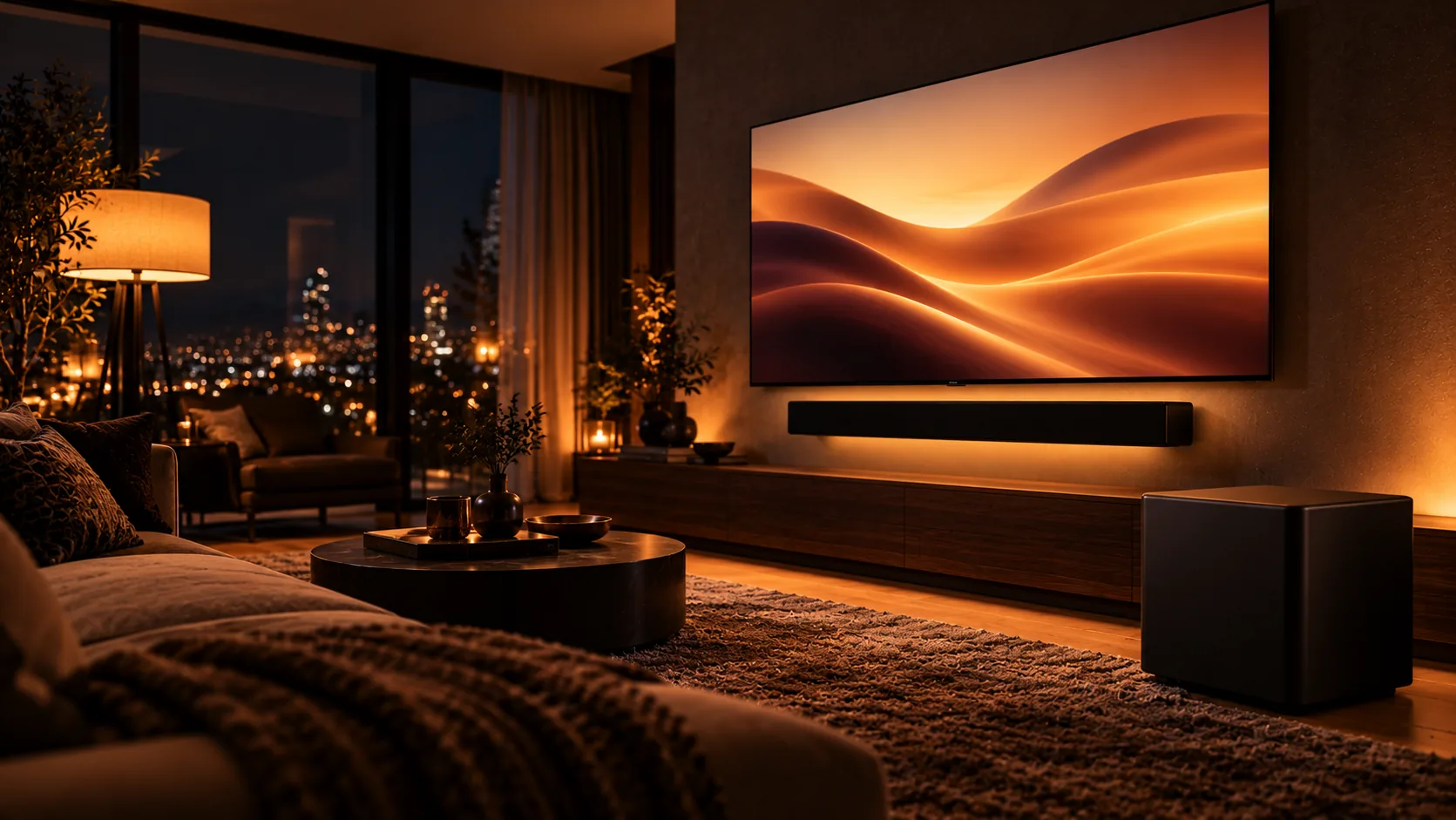
Physics: dead center under/over the TV, tweeter at seated ear height, nothing blocking the front. If the manual says “not inside the shelf”, the manual is right: a closed shelf is a baffle that buries everything.
Menu: three items count. The first is dynamics management: night/dialogue compression on only when needed, because it compresses films.
The second is sub level: start mid-way and set by ear on a dialogue scene, not on the opening titles.
The third is app calibration: the microprocessors in modern bars measure the room with your phone and equalize reflections and distances. It will not work geometric miracles, but between a calibrated bar and an uncalibrated one lies an entire weekend of viewing.
Frequently asked questions
Soundbar or receiver system? For 90% of people, a 3.1/5.1.2 bar: instant results, zero cabling, zero configuration. The separate component system wins on performance but asks for space, wires and willingness to configure.
Should the soundbar sit at TV height or sofa height? TV height: the bar’s center tweeter must travel horizontally toward seated ears, with no closed furniture in front. Genuinely simple: same plane as the panel, never inside a shelf.
Do I need a wireless sub? You need the sub; wireless is convenience: it removes the cable crossing the room. If the outlet is behind the bar, the wire bothers nobody and the saving is worth it.
Does a soundbar ruin the living room look? It is the question almost everyone uses to justify TV audio, then regrets. Current bars are 5-6 cm blades: they are less noticeable than a picture frame.
Why can’t I “hear” the sub? Because you look for it like a speaker: bass below 80 Hz is non-directional. If it booms, move it; do not crank the sub volume — it makes it worse.
With a good soundbar, do I also need a better TV? They are separate investments: the bar does not make the panel better, nor vice versa.
But between a richer bar and a bigger sub, the evening you hear the difference on an explosion you will understand why manufacturers fight over watts.
Sources
- Dolby Atmos Home Theater Installation Guidelines (official PDF: ceiling requirements)
- HDMI eARC (37 Mbps) vs TOSLINK (~384 kbps): format comparison
- How up-firing drivers and ceiling reflection work
- Ideal RT60 for home theater: 0.3-0.5 s

Gear and further reading
- Flagship 9.1.4 soundbar
- 2.1 Dolby Atmos soundbar (mid range)
- Compact 2.0 soundbar with virtual Atmos
- Budget 2.0 soundbar with Atmos
- 5.1.2 soundbar kit with rears and sub
- 7.2-channel AV receiver with Atmos and DTS:X
- 4K HDR streaming stick
- Smart subwoofer with auto calibration
- 2.1 TV system with Bluetooth
- 3 meter 48 Gbps HDMI 2.1 cable
Note: Some links on this site are affiliate links: if you buy through them we may earn a commission at no extra cost to you. Affiliate links are marked and never influence our recommendations.