You don’t need 7.1.4: you need the right level
Choosing among surround sound systems means choosing how many speakers you will actually live with. Compare soundbars and the glossary. Surround sound systems reward the measured, not the wealthy: three things matter — right level for the room, right format for the source, calibration to bind them.
Choosing among surround sound systems means choosing how many real speakers you are willing to see, wire and hide in your living room. The numbers on the spec sheets — 2.0, 5.1, 7.1.4 — are not a quality ranking: they are an address, and each digit tells a physical decision about your room.
This guide takes that notation apart digit by digit, explains what separates a real channel from a simulated one, and tells you when upgrading is actually worth it. No fluff: just how the formats work, because they do work.
The formats
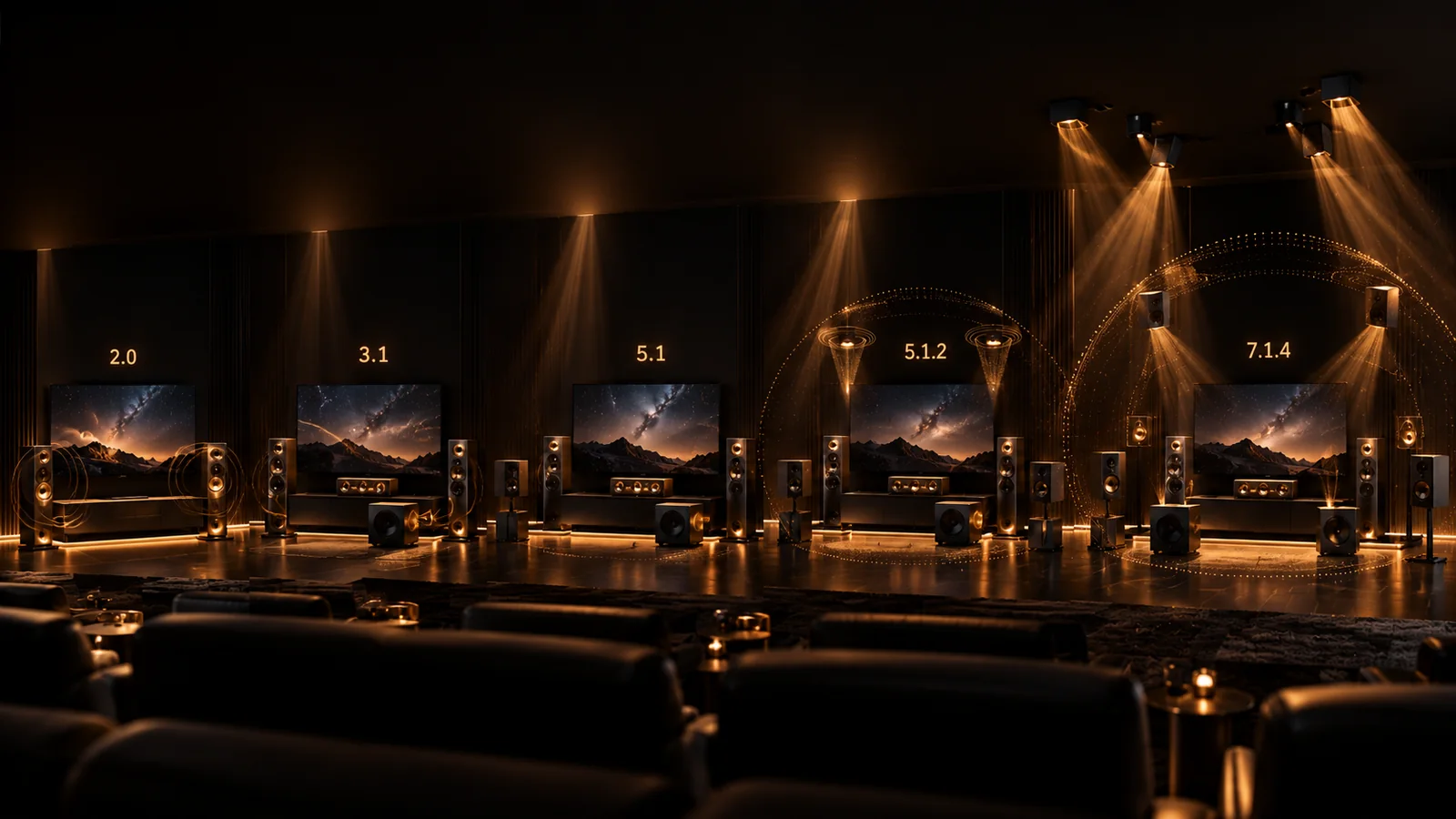
First the reading, because many stop there. In the X.Y.Z notation, the numbers before the dot are the ear-level channels (roughly fronts, center, rears), the number after the dot is the subwoofer, and a second dot means height channels — ceiling-mounted or ceiling-bouncing.
2.0 and 2.1: stereo, the base of everything
2.0 is pure stereo: one left channel, one right. 2.1 adds a crossover-managed subwoofer. It sounds like little; it is actually the decisive test: a surround system is judged by its front stage. If music and dialogue in stereo don’t convince you, no rear-speaker cable will save the system.
5.1: the sensible finish line
5.1 adds two fundamental things: a dedicated center channel, which anchors dialogue to the screen instead of leaving voices as a “phantom” between the two fronts, and two side/rear surrounds. For the vast majority of living rooms this is the right endgame: immersive, wireable, drivable by any modern receiver.
7.1: for long rooms
7.1 splits the surround effect into side and rear pairs. It makes sense when seats sit close to the back wall or the room is very long: the sides fill the listening area, the rears close the ring. In a small living room, where the surrounds are close together anyway, the second pair works little and the real gain is small.
5.1.2 and 7.1.4: the ceiling arrives (Atmos)
The second dot is the vertical dimension. Height channels are flush-mounted in the ceiling or sit as up-firing modules that ride on the ceiling reflection. Dolby’s installation guidelines set the reference elevation angle at 45° from the seat, acceptable between 30° and 55°, with a flat, reflective ceiling between roughly 2.3 and 3.7 meters.
| Format | What it adds | When it makes sense |
|---|---|---|
| 2.0 / 2.1 | Stereo front, optional sub | The mandatory base: if the front doesn’t convince, nothing does |
| 5.1 | Center + 2 surrounds | 90% of living rooms: immersive and wireable |
| 7.1 | +2 surrounds (side and rear) | Long room, or seats against the back wall |
| 5.1.2 / 7.1.4 | Height channels for Atmos | Flat reflective ceiling, 2.3-3.7 m |
Real and virtual channels
Here is where the catalog lies without actually lying: not every channel you read is a physical speaker. It pays to know what happens inside the box before you pay for a number.
LFE does not mean “the bass”
The 1 after the dot is the LFE channel, Low Frequency Effects: an effects-only channel recorded separately in the mix and bandwidth-limited by specification to roughly 120 Hz. It is not “the bass channel” of the whole film. The bass your crossover redirects to the subwoofer arrives anyway, but by a different path. A nerd distinction? Yes. One you can hear on a badly managed sub? Also yes.
The 80 Hz crossover: the THX reference
Below 80 Hz the ear localizes direction poorly: that is why THX and Dolby use 80 Hz as the bass-management reference threshold. Setting speakers to “Small” with an 80 Hz crossover sends everything below the threshold to the subwoofer, which handles it better, and spares amplification and distortion. “Full-range” speakers (the “Large” setting) are another thing entirely: panels reproducing the whole spectrum without a sub — legitimate in hi-fi, impractical in a living room.
DBL: the 5.1 that travels inside 2 channels
Your TV’s digital output often reads “Dolby Digital 2ch DBL”: that is Dolby Binary Logic, the technique that packs a multichannel stream into a stereo carrier and lets the receiver unpack it. It is why the TV’s optical port can deliver a 5.1 while physically carrying two channels. Convenient — but still a lossy compressed stream. If the system deserves better, move to HDMI eARC.
Dipole and bipole: surrounds that point at nothing
Dipole surround speakers mount two out-of-phase woofers: the listener sits in the acoustic null and perceives an enveloping field with no identifiable source. Bipoles mount them in phase: more direct energy, more presence. Dipoles are the classic choice for close side surrounds, bipoles for the back wall. That is physics, not marketing: the phase of the woofers changes the sound field.
Atmos: objects, not channels
Dolby Atmos changes the paradigm. In channel-based formats the mix is physically mapped: that rear-right channel comes out of that speaker, period. Atmos combines a channel “bed” with audio objects carrying position and movement metadata: it is the receiver’s processor, in real time, that decides which speakers emit the object to recreate the trajectory. That is why Atmos on 5.1.2 sounds “real” even without a speaker-by-speaker dedicated mix — and why a 7.1.4 without Atmos content is just a 7.1 with two extra channels.
Virtual: when psychoacoustics replaces the cable
Soundbars and “virtual surround” processors create phantom channels with delays and filtering that fool the ear’s localization. On good machines the result is a wider front and a fair sense of envelopment: never the physical wraparound of a rear behind your head. If the doubt is soundbar versus system, our complete soundbar buying guide separates the physical from the DSP.
When to upgrade
The upgrade rules, in order of return per euro.
From 2.0/2.1 to 5.1: when you watch films, not just series. The center channel alone fixes most “I can’t understand the voices” complaints, and the surrounds open up the room. It is the most perceptible jump in this entire guide.
From 5.1 to 7.1: geometry only. If seats touch the back wall or the room is long, the second pair earns its place. If your sides are already behind the sofa, you are buying a speaker that plays nearly the same note as the one next to it.
From 5.1 to 5.1.2: the accessible Atmos jump. Two height channels suffice for vertical objects. With a flat, rigid ceiling between 2.3 and 3.7 meters it is nearly always worth the money. With a slanted, beamed or absorptive ceiling there is no reflection to ride on: better spend that money on a better center.
From 5.1.2 to 7.1.4: the dedicated room. Four heights plus full rears make sense when you design the room, not when you endure it. If a dedicated room is in the works, start from the room’s numbers in our complete home cinema guide before choosing formats.
A reminder: before adding channels, cash in what you already have. A 5.1 with an 80 Hz crossover, a sensibly placed sub and a rug beats a randomly calibrated 7.1.4 in a bare room. Every time. Measurement and calculation tools are in our tools section.
Surround sound systems: frequently asked questions
Does the receiver need as many amplified channels as the format says? It needs to drive or pre-amplify them: many 7.2 AVRs run 5.1.2 by reassigning spare amplification to the heights. Look at real watts per channel, not the count of Dolby logos on the spec sheet.
Does a good 2.1 beat a cheap 5.1? For music yes, for films almost never: the dedicated center literally changes dialogue comprehension. Compare real front speakers in the buying guides category.
Gear and further reading
- Passive 5.1 home cinema set for an AV receiver
- Active 5.1 kit with optical inputs
- 5.1 kit with built-in digital decoder
- 7.2-channel AV receiver with Atmos and DTS:X
- Active 25 cm subwoofer for living rooms
- Smart subwoofer with auto calibration
- Speaker cable
- 3 meter 48 Gbps HDMI 2.1 cable
- 5.1.2 soundbar kit with rears and sub
- Universal remote for home cinema systems
Note: Some links on this site are affiliate links: if you buy through them we may earn a commission at no extra cost to you. Affiliate links are marked and never influence our recommendations.